
The Conservation Column
The Desecration of Saint Paul Mountain by BLM’s Last Chance Timber
by Erich Reeder
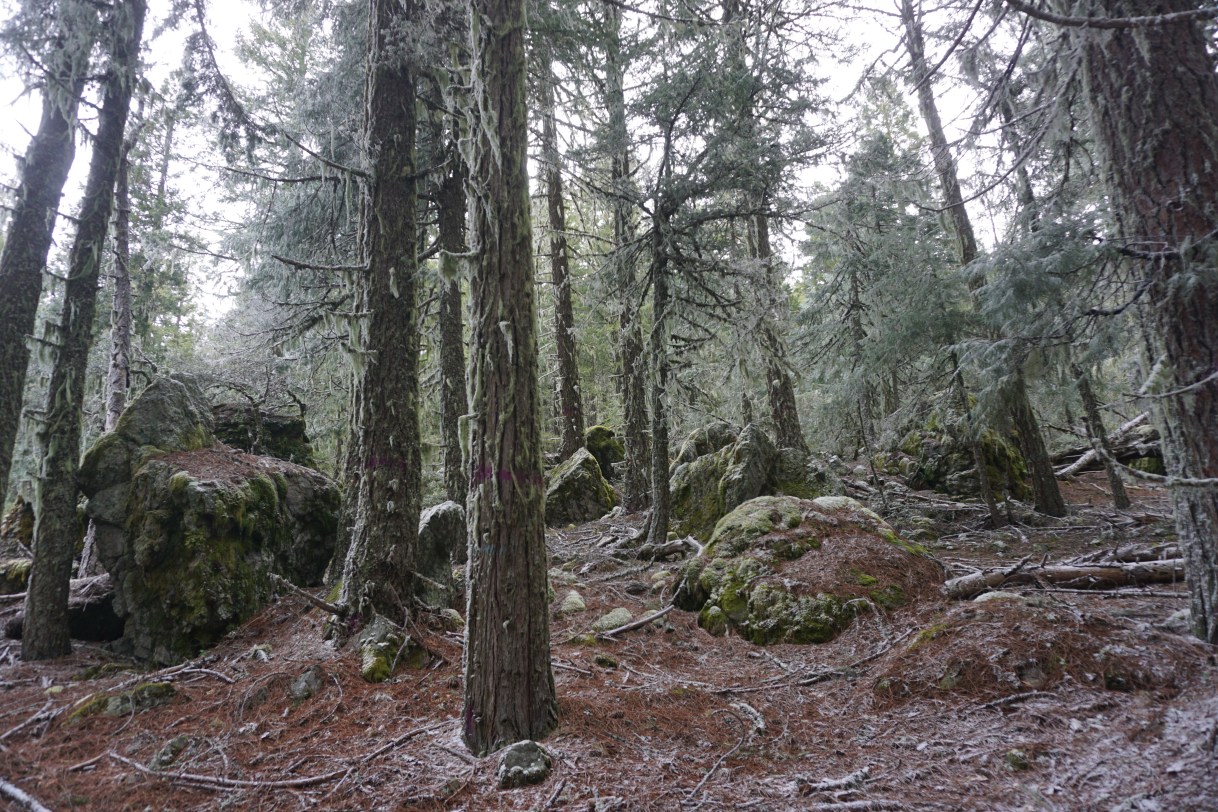
Saint Paul Mountain rises 4,255 feet above sea level just east of Sunny Valley in Josephine County, Oregon. A rounded peak of serpentine geology in the Klamath Mountain province, it has magnificent old-growth Ponderosa, Jeffrey, and sugar pine trees standing tall and mixing among old-growth Incense cedar and Douglas fir trees, all which age back 200 years or more. Beneath them is a fantastic understory of canyon-live oaks festooned with mosses and liverworts, and eye-catching rock outcrops spattered with colorful lichens that together form a sublime natural forest garden. Altogether, this forest also provides some of the highest quality nesting, roosting, and foraging habitat for endangered Northern Spotted Owls in the area. This is also our forest, or public forest, meaning this treasured landscape belongs to you and me, to care for how we choose. Most of Saint Paul Mountain has remained unlogged, particularly the square mile of public forest where this remarkable area is, and, until recently, was roadless as well.
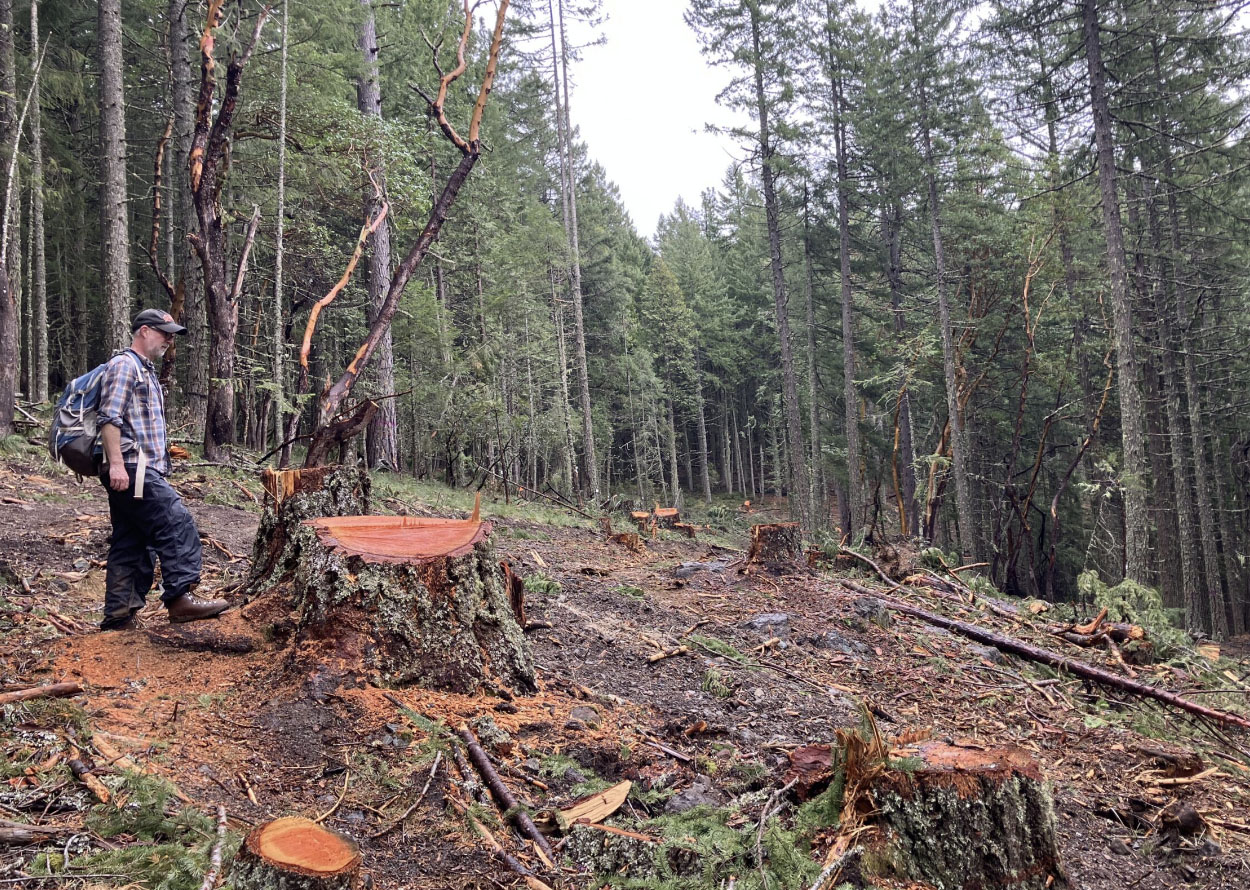
The Bureau of Land Management (BLM) has been entrusted to care for this forest for us, as well as another 2.5 million acres of our public forests in western Oregon. Managers at the Grants Pass Field Office, Medford District, have unwisely proposed to log this area, under the guise of reducing wildfire risk, as part of the Last Chance Forest Management Project, and spent considerable taxpayer dollars in the process. Western Environmental Law Council (WELC), on behalf of KlamathSiskiyou Wildlands Center (KS Wild), sued the BLM and the U.S. Fish and Wildlife Service (FWS) on Old-growth forest on St. Paul Mountain proposed for logging. legal grounds for, among other things, planning to log 6,248 acres of Northern Spotted Owl nesting, roosting, and foraging habitat, and for relying on a flawed analysis of the likely impacts to spotted owls based on a woefully outdated survey protocol. This blasphemous logging project has been paused for now for judicial review with a decision pending. Meanwhile, because of an ecologically frustrating loophole, road building has been permitted to continue, as if constructing a road through a pristine forest is simply a harmless endeavor. And so giant heavy machines—70,000-pound feller-bunchers and 50,000-pound bulldozers on metal tracks, 50,000-pound skid-ders, and/or 40,000-pound grapple-headed loaders were set loose to cut, gouge, and scrape a 100-foot wide ‘road’ for over a half mile through this serpentine sanctuary. Why so wide a road? So these giant machines can go to work. These actions have truly been a desecration of Saint Paul Mountain.
Historically, Saint Paul, who the mountain was named after, was originally Saul of Tarsus, a Pharisee or Greek-speaking Jew who persecuted early Christians shortly after Jesus was crucified. While traveling on the road to Damascus to find and arrest followers of Jesus, he was blinded by a brilliant light and heard a voice ask, “why do you persecute me?” Upon reaching Damascus, his sight was restored by a disciple of Jesus and Saul became Paul the Apostle who assumed the role of bringing the teachings of Jesus to the Gentiles, or non-Jewish people. Ever after, his sudden enlightenment has been seen as evidence of the divine grace available to all human beings to profoundly change their ways and this has been called a “road to Damascus moment.”
Standing among the shredded stumps, shattered serpentine rocks, and ruptured and compacted red earth of St. Paul Mountain, one wonders if the managers of our public forestlands at the BLM will ever have their road to Damascus moment and become enlightened to the ecological treasures they have been entrusted to care for us, or if they will continue to persecute and exploit the last of our magnificent unlogged and roadless living forests in exchange for board feet and coin. After all, they are allowed great discretion as to where to log and how to go about it and they did not have to go here. At this time, in 2026, we should be well past such brutal and ignorant abuse of our mature and old-growth public forests and our ecologically unique serpentine plant communities.
Indeed, this was an ill-conceived plan to begin with. The unique composition of tree species, old-growth structure providing high-quality spotted owl habitats, live oak understory, exposed serpentine, and open meadows should
have caught the eye of anyone upon doing the initial site inspection and the area set aside.
A similar action was carried out recently 50 miles north in the old-growth public forests of the Yellow Creek watershed of the Umpqua region. Likewise, while the BLM’s Blue and Gold Harvest Plan was paused for judicial review, towering old-growth trees were cut and a road carved into the pristine forest right during the nesting season of Marbled Murrelets, which had previously been detected nesting in all the surrounding forests. Nobody knows if one, two, three or more murrelet chicks tumbled to their deaths while this ‘road’ was being cut into the forest. Soon after this ecological travesty was committed, U.S. District Judge Kasubhai vacated the Blue and Gold Project Environmental Assessment (EA) and Finding of No Significant Impact (FONSI), finding the BLM had violated both the Federal Land Policy Management Act (FLPMA) and the National Environmental Policy Act (NEPA) by misrepresenting the age and structure of the mature and old-growth forests it was planning to log, and for failing to prepare an Environmental Impact Statement (EIS) for a plan with such potentially significant impacts to old-growth forests, Northern Spotted Owls, and Marbled Murrelets. Nevertheless, the damage from the newly constructed road has been done, senselessly frag-menting an old-growth forest which serves as prime habitat for inland nesting Marbled Murrelets.
This does not need to be, and should not be, an adversarial relation-ship between ourselves as landowners and BLM staff as our property managers. They are our friends and neighbors, members of our communities and, in-deed, many of our RVAS members have had careers at one or more of the agencies who oversee our public lands and wildlife. We need to keep a dialog open with our friends at all our federal, state, and local agencies, encourage them to have courage, honesty, and transparency, let them know that we are paying attention and that we want healthy forests, streams, and wildlife populations.
As to Saint Paul’s revelation, it is unrealistic, of course, to expect sudden enlightenment to strike anyone, especially those securely cocooned in government offices. But a steady, encouraging dialog may make enough progress over time to reach the same point of ecological awareness and respect for our public forests among even the most hardheaded and timber-centric man-agers of our public lands.
However, it is also ourselves who must continue to become enlightened to the present situation and act accordingly by engaging with our local, state, and federal representatives and advocating strongly and resolutely for legislation that will conserve the last of our mature and old-growth public forests from such senseless, reckless, and needless destruction. We are the shared landowners, after all, and when we become sufficiently enlightened, we will insist on hiring better, more ecologically enlightened managers of our property and give them clear instructions to conserve our unique and beautiful wild public places.
To this end, it is vital that we continue to pay attention, engage, make comments, and assert our rights of shared ownership. We are a conservation organization, with the mission “to support the conservation and restora-tion of ecosystems so that birds and other wildlife may flourish,” and we should let it be clearly known that we want to continue to have Northern Spotted Owls, Marbled Murrelets, Bald Eagles, Pileated Woodpeckers, Chestnut-backed Chickadees, Pacific Wrens, neotropical migrants and other forest nesting birds and animals in our forests and that we will stand up to conserve their nesting and foraging habitats for them. Let us continue to remind one and all that we love our public lands and the birds and other wildlife who need these wild places, no matter how small, to live their lives however they may, and that we will continue to ring the bell for conservation.

Leave A Comment
You must be logged in to post a comment.