
The Conservation Column
by Pepper Trail
Proposed Repeal of the Roadless Rule
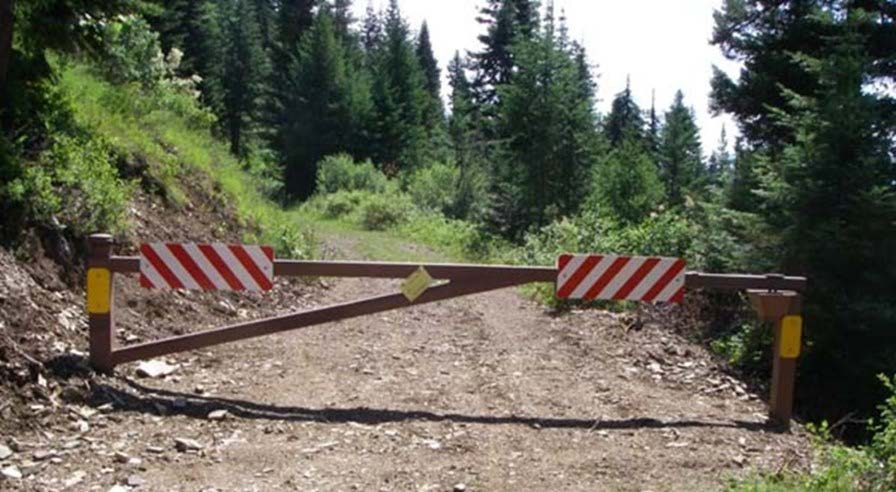
Since 2001, the US Forest Service’s Roadless Rule has limited development for over 50 million acres of National Forests across the country. The premise behind the Roadless Rule is simple: to limit road-building and commercial logging in order to maintain wildlife connectivity and habitat.
In August, Department of Agriculture Secretary Brooke Rollins announced that the Trump Administration wants to rescind the 2001 Roadless Rule, claiming it is a burdensome regulation that prevents “responsible” management of our National Forests. However, it is clear that the new rule is designed to comply with President Trump’s Execu-tive Order 14225 to expand commercial logging on public lands. The rule is misguided and skews the reality of what they’re trying to do:
• During last year’s scoping comment period, the US Forest Service received over 600,000 public comments. More than 95% of submissions were in support of keeping the Roadless Rule intact. The agency also acknowl-edges that the vast majority of Tribes are supportive of keeping the Roadless Rule protections in place.
• The US Forest Service has a maintenance backlog of $6 BILLION on its existing road network. At a time when this administration is cutting back on agency budgets and staffing, including the US Forest Service, it makes no sense to add more maintenance and upkeep expenses to a road system that seems destined to fail given extreme weather events like wildfire and floods.
• Building more roads under the guise of wildfire risk management could actually backfire. Research and analy-sis show that forested areas with heavier road densities will see more wildfire activity than unroaded/undeveloped areas. Humans are the leading cause of wildfire, with nearly 85% of ignitions and starts being human-caused.
• Roadless Areas are drinking water sources for many communities. Across the country, more than 60 million people rely on drinking water that origi-nates or flows through National Forest lands. In places like Ashland, Oregon, roadless areas are located within watersheds that supply the communi-ty with fresh drinking water.
• Outdoor recreation is growing and becoming an im-portant economic driver for many Western commu-nities. According to the Outdoor Alliance, Roadless Areas across the country are home to 800 miles of whitewater paddling and 8,000 different climbing routes. There are more than 45,000 miles of hiking and mountain biking trails, in addition to numerous quiet recreation spots for birders, hunters and fishing enthusiasts.
• The fragmentation that will be caused by increased logging and road-building will degrade wildlife habitat and expose forests to greater impacts from climate change.
To submit your personal comment to the Forest Service:
• Visit the regulations.gov webpage (https://www.regulations.gov, identified by docket number FS-2025-0001 or RIN 0596-AD66).
• Click on the blue “comment” button in the top left corner.
• Type your comment or upload a document. You can use these talking points from KS Wild as inspiration to write your comment.
• Submit! The comment deadline is October 6.
Ashland is Selling the Imperatrice Property, Act Now to Insure the Sale Has Conservation Conditions
As reported in the May RVAS Chat (https://tinyurl.com/mtf73zfs), the Ashland City Council has decided to sell the 846-acre Imperatrice property, located east of I-5 above the ODOT weigh station. This ecologically precious grassland is home to rare and endangered plants, as well as one of the largest nesting colonies of Grasshopper Sparrows in Oregon.
The City Council is under pressure to sell the property to the highest bidder, regardless of their plans for the property.
Although the land is zoned Exclusive Farm Use, that would not preclude a buyer dividing the property into a number of residential parcels as long as there is “farm income.” And EFU zoning would also allow placing solar arrays on the property.
Almost all the private land east of I-5 from Emigrant Lake to Medford has been chopped up into ranchettes, vineyards, and hemp farms. No one wants that to be the fate of this unique large intact grassland.
The Ashland City Council has fiscal responsibilities. But it also has responsibilities to honor the values which this town holds dear, including the preservation of open space, the protection of rare and threatened species, and community involvement in land use decisions.
The time is NOW to contact the Ashland City Council, before the sale terms are finalized. Advocate that conditions be placed on the sale of the Imperatrice, to keep it intact and preserve its ecological value. For example, livestock grazing should continue to be excluded from the large native grassland area above the Talent Irrigation Ditch. Ideally, a conservation organization such as the Southern Oregon Land Conservancy would take over the property and its management.
Insist that this irreplaceable grassland must not be sacrificed to subdivision and development! The link for comments to the Ashland City Council is: https://ashlandoregon.gov/FormCenter/City-Council-16/Contact-City-Council-111
Botulism Outbreak in the Klamath Basin
Many of you will have heard that drastically low water levels and high temperatures have led to another deadly outbreak of botulism at the Klamath National Wildlife Refuges. While not as catastrophic as the outbreak in 2024, this has killed up to 14,000 birds, according to refuge biologists. As in previous years, a “Duck Hospital” set up by the group Bird Ally X is working to save as many birds as possible. Rogue Valley Audubon Society has donated funds to support this critical work.
Fortunately, the outbreak appears to be easing, thanks in part to an agreement between the Klamath Water Users Association, the irrigation districts, and the Bureau of Reclamation to move more water into the refuges. This has lowered water temperatures and provided more oxygen, making conditions less favorable for the botulism bacteria. For more information, see this excellent OPB story by our own Juliet Grable: https://www.opb.org/article/2026/09/01/klamath-basin-southern-oregon-bird-crisis-water-rivals-botulism/

Leave A Comment
You must be logged in to post a comment.